

Reflective Insulation Film vs. Traditional Insulation Boards for Underfloor Heating
Choosing the right insulation for an underfloor heating system quietly determines whether the system runs efficiently for decades or wastes energy from day one. Two options dominate the conversation among contractors and designers: reflective insulation film and traditional rigid insulation boards. Each has a legitimate role. This piece cuts through the marketing noise and puts them side by side where it counts.
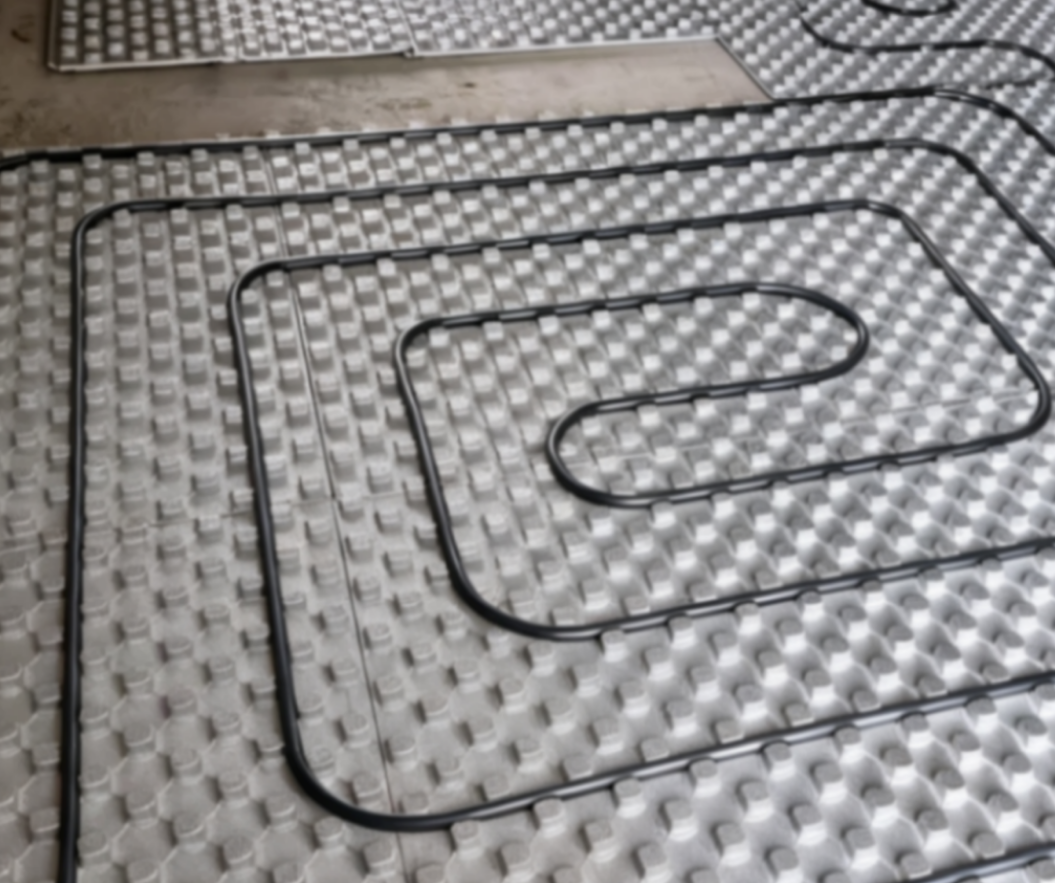
How R-Value Actually Behaves Here
The thermal resistance of a material matters enormously under a heated floor, but R-value alone does not tell the whole story. Rigid foam boards advertise R-values in the range of R-4 to R-7 per inch, depending on the type (XPS, EPS, or PIR). Reflective insulation film achieves its thermal performance through a different mechanism — a low-emissivity aluminum surface that redirects radiant heat rather than relying on bulk resistance alone.
One nuance that trips people up: the stated R-value of a reflective product is heavily dependent on the air gap maintained on either side of the film. Lose that gap — say, by compressing the film under a heavy screed — and performance drops sharply. Foam boards, on the other hand, are far less sensitive to adjacent air conditions. If your spec calls for direct contact between the insulation layer and the heating element, foam boards behave more predictably. If the design preserves an air gap, reflective film often outperforms per millimetre of thickness.
Thickness and Weight: The Floor Build-Up Equation
Every millimetre of floor build-up matters in renovation projects where ceiling height or door clearances are fixed. A typical rigid PIR board at 30 mm thick delivers an R-value of roughly R-6. A comparable reflective film system can achieve equivalent thermal separation in 5–10 mm total thickness. That difference translates directly into headroom — or the ability to avoid relocating radiators, door frames, and stair treads.
Weight is another practical consideration. A roll of reflective film from a manufacturing supplier weighs a fraction of what a pallet of insulation boards does. For a two-storey renovation where all materials must be carried upstairs by hand, that distinction shapes the logistics plan significantly.
Cost Across the Full Project Lifecycle
Upfront material cost for foam boards and reflective film are roughly comparable at the consumer level — roughly $5–12 per square metre for both, depending on grade and region. But cost cannot be evaluated in isolation from installation. Reflective film is typically rolled out in a single pass, taped at seams, and is ready within hours. A comparable board installation involves cutting, fitting around pipework, sealing joints, and dealing with off-cuts that cannot always be reused.
Our factory has supplied both products to commercial projects, and the labour-time differential on a 100 m² floor has been as much as two full working days in favour of reflective film. Add in reduced screed volume due to thinner build-up, and the total installed cost frequently tips in film's favour — particularly on larger projects.
Moisture and Long-Term Durability
Moisture is the silent enemy of any floor insulation system. Rigid foam boards are closed-cell products and resist water absorption to a degree, but they offer no vapour barrier on their own. Additional damp-proof membrane layers are routinely specified alongside them, which adds both cost and complexity.
Reflective film with an integrated oxygen-barrier layer handles this differently. The multi-layer construction inhibits both vapour transmission and radiant heat loss in a single step. In ground-floor installations over concrete slabs, that dual function removes one whole trade from the programme. On upper floors with timber subfloors, the same property helps manage interstitial condensation risk without a separate membrane.
When Foam Boards Win
There are scenarios where rigid boards earn their place. In high-load environments — commercial kitchens, workshops, spaces with heavy point loads — a foam board's compressive strength is higher than most reflective films can offer without additional protection. Boards also perform better when the insulation layer will be walked on during the construction phase before the final floor finish is laid.
Another situation: retrofits where the existing floor is deeply uneven. Boards can be shimmed and cut to accommodate irregularities that would stress a flexible film. And where fire-rated specifications are mandated, some foam board products carry certifications that reflective films cannot match without additional cladding.
When Reflective Film Is the Smarter Choice
For standard residential installations — particularly in new builds or renovations with clean, flat substrates — reflective film consistently delivers better thermal performance per millimetre of build-up. It is the product our supply network reaches for when clients ask how to keep floor height impact minimal without sacrificing efficiency.
Hybrid systems are worth a mention: a thin foam underlayer covered with a reflective top layer combines the vapour resistance of the board with the radiant redirection of the film. Several manufacturers now produce hybrid products specifically for this purpose, gaining traction in markets where floor thickness regulations are tightening.
The Honest Verdict
Neither product is universally superior. Foam boards excel where structural robustness and code compliance for point loads dominate the brief. Reflective film excels where thermal efficiency, speed of installation, and minimising floor build-up are the driving factors. On most residential underfloor heating projects, reflective insulation film wins on total installed cost and thermal performance — provided the installation instructions are followed carefully, particularly the requirement to maintain an effective air gap.
References
Reflective Insulation Manufacturers Association International. (2014). Understanding and Using Reflective Insulation, Radiant Barriers and Interior Radiation Control Coatings. RIMA-I.
U.S. Department of Energy. (2023). Radiant Barriers: Energy Saver Guide. Office of Energy Efficiency and Renewable Energy.
European Committee for Standardization. (2017). EN ISO 6946:2017: Building Components and Building Elements — Thermal Resistance and Thermal Transmittance — Calculation Methods. CEN.
American Society of Heating, Refrigerating and Air-Conditioning Engineers. (2021). ASHRAE Handbook—Fundamentals, Chapter 26: Heat, Air, and Moisture Control in Building Assemblies. ASHRAE.